
UNMASKING THE ROOTS OF PARENTAL DISCARD | CLICK TO EXPAND
The Perfect Storm: What Shaped the 1985-2004 Generation
Digital Natives
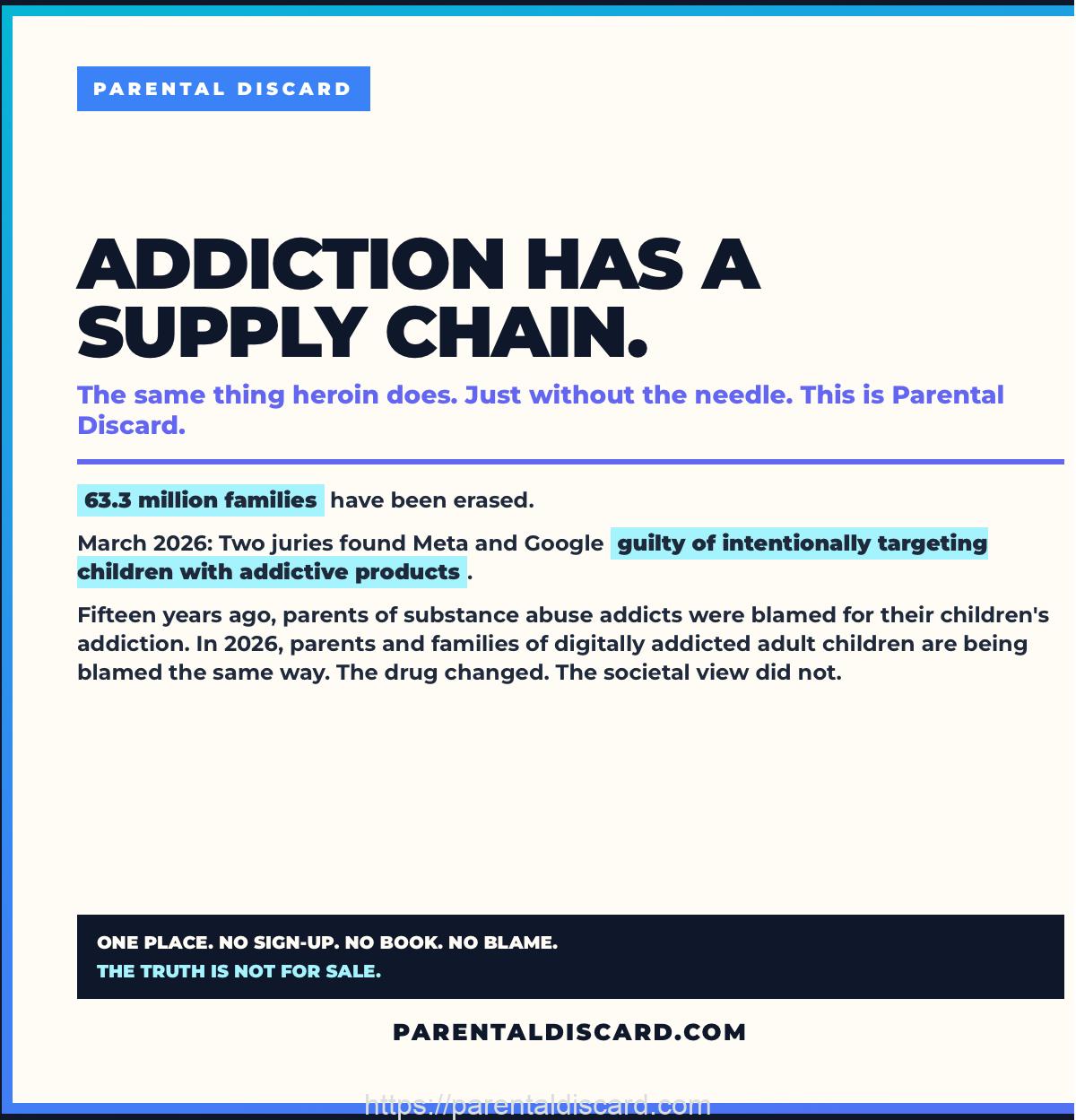
This generation (1985-2004) were the last generation to receive a secure attachment figure (Bowlby, Ainsworth), disrupted by normal development while the brain was still making critical decision making skills the identity transfer and neural pathways were altered by Digital techniques, that created the “screen Persona” throughout their adolescent years. They were targeted purposely, by social media developers, creating an “addictive” nature, which occurred at a vulnerable time. Documented brain structures and pathways have physically rewired the human brain, In the absence of human growth, substituted with the screen personaParentalDiscard.com | M.F. Shaw MsPSY | 2025-2026 All Rights... More, when the brain matures (later) at approx 25-30 years this is when Parental Discard is occurring in mass.
Therapy Culture
This generation was raised within a framework of biased and unregulated definitions of “therapy culture,” where clinical language is often applied without clinical oversight to pathologize normal family life. Clinical terms are used as a weapon to pathologize normal family dynamics.
Identity Focus
True identity is in fact lost. This generation has traded or morphed from what was once a sense of true self, and exchanged for a digital identity. The authentic self has traded been replaced with superficial screens.
Online Echo Chambers
Online echo chambers are everywhere across all social media. The uglier the better, the more extreme, the more they identified with the “Online Persona.” The self has traded and reimagined their youth for superficial screens, online echo chambers are everywhere across all social media.
This generation came of age during a unique cultural moment when social media created echo chambers where cutting off parents became normalized and celebrated. Therapeutic language became mainstream, making it easy to pathologize normal family dynamics. Identity politics emphasized self-definition over family loyalty or historical context. Cultural narratives shifted to automatically believe the “victim” without examining evidence.
The cultural conditions that enable and reinforce Parental Discard emerged during their formative years—and we are the victims of their decisions. They are accountable and there is zero excuse for their actions past, present or future.
The Erasure Extends Beyond You
Perhaps one of the most devastating aspects of Parental Discard is how it metastasizes through your entire family system.
Parental Discard demands absolute loyalty. Your adult child often requires extended family members, siblings, and even your other children to choose sides. Anyone who maintains contact with you becomes suspect. Anyone who questions the narrative gets cut off too. This is the hallmark of Parental Discard.
“My son told his sister she could either ‘support his healing’ by cutting me off, or she could ‘enable my toxicity’ by staying in contact. She is 29. She chose him. Now I have lost both children.”
This systematic family destruction serves multiple purposes. It eliminates witnesses who might contradict the new narrative. It increases your isolation, making it harder to get support or validation. It reinforces the adult child’s identity as someone who escaped a toxic family. It creates social proof for their decision.
The Manufactured Narrative: How Your History Gets Rewritten
One of the most painful aspects of Parental Discard is watching your family history get systematically rewritten. Events you remember as normal—or even positive—are suddenly reframed as profound negative experiences.
Parental Discard operates differently. The adult child constructs a new narrative that justifies the elimination. This narrative often includes retroactive (after the fact) labeling, where normal parenting decisions are reframed. It includes memory revision, where positive or neutral events are recalled as harmful. Clinical therapy vocabulary is applied to non-clinical situations. Zero substantiation is provided for claims made without evidence. Absolute framing is used, where you are either “unfit” or “unsafe,” with no room for complexity.
“My daughter told her therapist I was ’emotionally abusive’ because I asked her to call when she would be home late as a teenager. That is now her justification for cutting off contact. No conversation. No chance to respond. Just… labeled.”
The Body Keeps the Score: Your Physical Response Is Real
If you are experiencing Parental Discard, you have likely noticed that your body is responding as if you have experienced a physical, profound confusion.
This is NOT just emotional distress. Parents facing Parental Discard often report sleep disruption, physical pain, hypervigilanceA heightened state of alertness and scanning caused by traum... More, and intrusive thoughts. Avoidance of triggers such as small children or sentimental places is common. Symptoms are consistent with PTSD. Many find it difficult to trust their instincts and begin second guessing every decision or relationship in their lives.
Parental Discard triggers biological threat responses. Your nervous system recognizes the sudden, unexplained rejection by your child as a fundamental threat to your survival and identity. This is not weakness. This is biology.
Society’s Role in Your Pain
This cultural shift enables and reinforces Parental Discard.
Your adult child receives validation at every turn. Social media celebrates “cutting off toxic family members.” Therapists may reinforce the Parental Discard without ever meeting you. Friends applaud their “bravery” in “setting boundaries.” Popular culture portrays parents as inherently flawed or harmful.
Meanwhile, you are silenced. If you speak up, you are told you are not “respecting their boundaries.” If you share your pain, you are accused of “playing the victim.” If you question the narrative, you are “in denial.”
“I tried joining an estrangement support group. Within minutes, I was told that if my daughter cut me off, I needed to ‘examine my behavior’ and ‘respect her decision.’ When I explained there was no warning, they said that proved I was not listening.”
What You Can Do Now
Understanding that you are experiencing Parental Discard—not traditional estrangement—is your first step toward genuine healing.
Stop Blaming Yourself
You did not cause this through normal parenting decisions. You did not miss obvious warning signs. You were not given a chance to address concerns. This was done to you, not caused by you.
Document Your Experience
Track communication patterns, save messages, and note dates. A factual record helps you resist gaslighting and self-doubt that comes with manufactured narratives.
Recognize Your Feelings and Reactions as Real
Your physical, biological and emotional responses are appropriate responses to a profound relational severance. Seek support from those who understand Parental Discard specifically.
Stop Waiting for Reconciliation
Hoping for reconciliation keeps you stuck. You can hold space for the possibility while still building a life that does not depend on it. Releasing false hope is not giving up—it is choosing to survive.
For Professionals: The Cost of Confusion
If you are a therapist, counselor, or family professional, understand this: conflating Parental Discard with traditional estrangement causes immense harm.
- Automatically assuming the parent “must have done something”
- Encouraging discarded parents to “give space” or “respect boundaries”
- Applying estrangement frameworks to Parental Discard situations
- Reinforcing adult children’s Parental Discard narratives without examining evidence
- Failing to recognize the physiological responses of sudden relational elimination
Professionals need clear distinctions between Parental Discard and estrangement in family work. The interventions are not the same. The outcomes are not the same. The behaviors are not the same.
Stop endorsing total cutoffs without examining evidence or proportionality. Question narratives built without records or witnesses. Recognize that therapy language can be weaponized to justify relational elimination. Most importantly: believe discarded family members when they tell you their experience. They are not all “at fault.” They are struggling.
The Path Forward: From Confusion to Clarity
Now you know the truth: you are experiencing Parental Discard.
Parental Discard is real. Your experiences are valid. Your story matters. Building an understanding that this Parental Discard was devised to destroy families allows you to begin genuine healing at your own pace.
You deserved better. You deserve healing. You deserve to be believed.
The road ahead will not be easy. However, now you are walking it with clarity, with validation, and with the knowledge that your experience is real—and that you are not facing it alone.
Coming Next Month: Part 2 of Estrangement or Parental Discard: Insights for professionals, the Path Forward, and Visuals for Determining is this Parental Discard or Estrangement?
© 2026, 2025 Parental Discard™ — All Rights Reserved
@ParentalDiscard | https://parentaldiscard.com
A Deliberate Process: Unmasking the Roots of Parental Discard in the 1985-2004 Cohort
“Estrangement: Children leave a bad home to find peace.
Parental Discard™: Adult children erase a good home to protect a fake identity.”
— M.F. Shaw, MSPSY
“Estrangement: Children leave a bad home to find peace.
Parental Discard™: Adult children erase a good home to protect a fake identity.”
— M.F. Shaw, MSPSY
To understand Parental Discard™, you cannot start with the family. You have to start with a specific generation, a specific technology, and a precise window of biological vulnerability that no previous generation in human history ever faced.
The 1985–2004 cohort are the Architects. They were the last generation to receive secure, face-to-face attachment — the kind Bowlby and Ainsworth documented as foundational — with no screens during those critical early years. Real eye contact. Real touch. Real voice. A genuine bond with their parents, built entirely in the analog world.
Then they came of age during the exact years Silicon Valley deployed its conditioning engines. Not a coincidence. A collision. And the result was permanent.
THE TEENAGE BRAIN:
GAS PEDAL. NO BRAKES.
The adolescent brain does not develop evenly. This is documented neuroscience. And it is the exact vulnerability Big Tech identified and targeted.
THE LIMBIC SYSTEM
The emotional and reward-seeking center. Driven by dopamine. Fully active by early puberty. Makes teenagers acutely sensitive to social approval, peer acceptance, and external validation.
THE PREFRONTAL CORTEX
Impulse control. Long-term planning. Understanding consequences. Does not fully mature until the mid-twenties. Teenagers are biologically wired to crave reward — and structurally incapable of stopping themselves.
⚡ Maximum emotional drive. Minimum logical control. This is the window Silicon Valley deliberately targeted.
HOW A LOVING CHILD
BECOMES THE DISCARD
Seven documented stages. Each building on the last. Tap through to follow the progression from the analog foundation to the inevitable collision.
THE ANALOG CHILDHOOD
The story begins with a normal, healthy childhood. For the first years of this generation’s lives, their brains developed entirely offline. Eye contact. Touch. Voice. Secure attachment — exactly as Bowlby and Ainsworth documented.
The parent and child were genuinely bonded. This is what makes the discard so devastating — and so confusing. The love was real.
THE BIOLOGICAL VULNERABILITY
As this generation approached puberty, the brain’s emotional center — the limbic system — matured fully. The logical center — the prefrontal cortex — was years away.
Maximum emotional drive. Minimum logical control. This is not a character flaw. This is documented developmental neuroscience. And it is the vulnerability that was deliberately targeted.
THE TROJAN HORSE
The smartphone arrived. Initially harmless — a music player, a map, a phone. Parents willingly bought these devices for their children because they seemed useful and benign.
The weapon was inside the tool before anyone recognized it as a weapon.
THE CONDITIONING ENGINES
Tech companies stopped building tools and started building slot machines. The Like button. Pull-to-refresh. Infinite scroll. Red notification dots. Every feature was engineered using casino psychology — variable ratio reinforcement — to create compulsive behavior.
Social validation — once a human experience — was turned into a quantifiable numerical score. And the score had to go up.
THE NEUROLOGICAL REWIRING
fMRI brain scans document what happened. Receiving likes activated the Nucleus Accumbens — the exact same reward circuit involved in behavioral compulsion.
Gray matter in the prefrontal cortex physically atrophied. The amygdala became hyper-vigilant. This is not metaphor. This is measurable, documented, peer-reviewed structural brain change.
THE DIGITAL IDENTITY
Many failed to develop a stable, independent sense of self. Instead they developed self-worth entirely dependent on external digital metrics. To survive online, many adopted narratives of victim mentality or grievances.
They claim they are healing. They claim chosen family. But they do not need family replaced. They only need an audience.
THE INEVITABLE COLLISION
The parent holds the authentic memory of the child’s analog past. A loving childhood. Real history. This memory directly contradicts the victim-centered identity the adult child constructed online.
The conditioned brain registers the parent’s existence as a structural threat. Rather than face accountability, the adult child takes the path of least neurological resistance.
This is not a family dispute. This is a documented neurobiological defense mechanism. The Great Reversal: adult children execute absolute removal to protect a fake identity from a loving family.
THE ENGINEERS WHO
BUILT THE TRAP
These were not accidents. The architecture was deliberately designed — and the people who built it later admitted it. These admissions are on public record.
The “Like” Button
Created by Justin Rosenstein. Turned social interaction into a numbers game. Quantified human validation for the first time in history.
Pull-to-Refresh
Designed by Loren Brichter. Mimics a slot machine lever. The unpredictability creates severe psychological craving.
The Infinite Scroll
Invented by Aza Raskin. Removes stop cues. Content loads endlessly. The brain loses all track of time.
Red Notification Dots
Red — a biological threat-trigger color — was substituted for blue. The brain processes it as an alarm demanding immediate attention.
“The short-term, dopamine-driven feedback loops we have created are destroying how society works.”
— Chamath Palihapitiya, former Facebook VP of User GrowthWHAT THE BRAIN SCANS
ACTUALLY SHOW
Not theory. Not opinion. Brain imaging technology documents specific, measurable, permanent changes in the adolescent brain under chronic digital exposure.
📉 Gray Matter Atrophy
Physical shrinkage in the prefrontal cortex — the DLPFC and OFC. The brain regions responsible for decision-making and impulse control are structurally smaller. Yuan et al. (2011) · Solly et al. (2021)
📈 Enlarged Reward Center
Increased gray matter volume in the nucleus accumbens. The brain physically built more tissue to process digital rewards. Brand et al. (2014) · Volkow et al. (2011)
⚡ Degraded Wiring
White matter microstructural damage — corpus callosum, corona radiata. The physical cables required to transmit stop signals are compromised. Mohammadi et al. (2023)
🚨 Permanent Hyper-Vigilance
Amygdala alterations leave the adult highly reactive and emotionally volatile. Any perceived threat triggers immediate defensive response. Flannery et al. (2022)
THE PARADIGM SHIFT
Every classic theorist — Bowen, Bowlby, Kohut — built their models on the premise that the family system was broken.
The Parental Discard™ framework proves that the family system was functioning. The adolescent brain was algorithmically hijacked — and permanently restructured before it finished developing.
WHAT NEVER
GOT BUILT
When the brain trades real-world experience for a screen during its formative years, the fundamental human capacities built only through face-to-face consequence never fully form.
Empathy
Built by reading real human faces, voices, and bodies in real time. Replaced by emoji and reaction counts.
Accountability
Formed through the direct impact of actions on real people in real time. Bypassed by the ability to block, delete, and curate reality.
Conflict Resolution
Learned by staying in the room when it is uncomfortable. Replaced entirely by ghosting.
Identity
Supposed to be built through real-world trial, failure, and recovery. Built instead on a digital persona optimized for strangers’ approval.
“When a parent — who holds the authentic memory of who this person actually was — stands in front of that incomplete structure, they are not a problem to be solved. They are evidence of what was lost. And the system cannot tolerate the evidence.”
— M.F. Shaw, MSPSY · ParentalDiscard.comRESEARCH FOUNDATION
The following peer-reviewed studies and documented sources form the empirical basis for the neurobiological framework presented on this page.
Yuan, K., et al. (2011). Microstructure Abnormalities in Adolescents with Internet Addiction Disorder. PLoS ONE.
Solly, J.E., et al. (2021). Structural gray matter differences in Problematic Usage of the Internet: systematic review and meta-analysis.
Brand, M., Young, K.S., & Laier, C. (2014). Prefrontal control and Internet addiction. Frontiers in Human Neuroscience.
Mohammadi, S., et al. (2023). White matter microstructural changes in internet addiction disorder. Addictive Behaviors.
Shen, Y., et al. (2023). The Effects of Digital Addiction on Brain Function and Structure of Children and Adolescents: A Scoping Review.
Sherman, L.E., et al. (2016). The Power of the Like in Adolescence. fMRI evidence of nucleus accumbens activation from social media likes.
Flannery, J.E., et al. (2022). Association of Habitual Checking Behaviors on Social Media With Longitudinal Functional Brain Development. JAMA Pediatrics.
Volkow, N.D., et al. (2011). Addiction: beyond dopamine reward circuitry. PNAS.
Lewis, P. (2017). ‘Our minds can be hijacked’: the tech insiders who fear a smartphone dystopia. The Guardian.
Bowlby, J. (1969, 1973, 1980). Attachment and Loss (Vols. 1–3).
Ainsworth, M.D.S., et al. (1978). Patterns of attachment: A psychological study of the strange situation.
IS THIS PARENTAL DISCARD
OR ESTRANGEMENT?
The distinction is not semantic. The misclassification causes measurable harm. Take the research-based assessment.
|
Peer-Reviewed Research · Education